

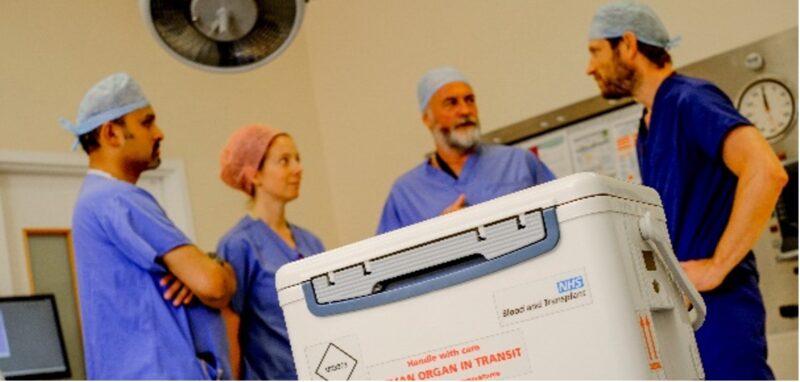
Four years after the law was changed to presume permission for organ donation upon a person’s death unless otherwise indicated, Clare Harvey looks at how the law came about, how it works — and what it means.
The Organ Donation (Deemed Consent) Act 2019 was enacted in May 2020 when regulations to accompany the Organ Donation Act were approved in the House of Commons.
The Welsh Assembly had already introduced its own opt-out law in the Human Transplantation (Wales) Act 2013, five years earlier, in 2015.
Why did the law change?
There has been a longstanding shortage of donors in the UK. In 2008 the Department for Health’s Organs for Transplants report recommended that “All parts of the NHS must embrace organ donation as a usual, not an unusual event”.

But despite a million additions to the Organ Donor Register each year, John Forsythe, Medical Director of organ donation and transplantation for NHSBT said in 2019 that every day in the UK three people were dying while on the transplant list.
The waiting list for organ transplants — known as the active transplant list — is now the longest it has been in 10 years. There were 7,515 patients waiting for suitable donors on 17th May 2024, according to the NHS Blood and Transplant Service (NHSBT) — an increase of 2,500 patients since the legislation was announced.
What prompted the law change?
The Cox family, who pushed for the creation of a centralised organ donor register in 1994, also campaigned for an opt-out system.
But the political will was not there, despite public opinion being broadly in favour.
In 2017, Prime Minister Theresa May pledged to nine-year old transplant survivor Max Johnson that she would change the law. Max survived a disease of the heart muscle following a successful transplant from donor Keira Ball.
Two years of campaign pressure from the Daily Mirror kept the issue in the public eye.
Labour MP Geoffrey Robinson won a private members’ ballot and introduced the draft bill in 2017. Unlike the parliamentary ‘ping-pong’ seen with the Rwanda bill, the Organ Donation bill was supported by MPs from seven different parties, and achieved consensus on its second reading.
Three former prime ministers declared their support and a public consultation of 17,000 people contributed to the bill’s progress. In a speech to the House of Commons Barnsley MP Dan Jarvis said” “This is parliament at its best.“
It took less than two years of discussion for a political decision to be made. Royal Assent then passed the bill into an Act of Parliament.
How does it affect me?
- If diagnosed with an illness, such as heart or kidney failure, liver disease or diabetes, you could benefit from a donation.
- Potential recipients face a long wait for a suitable match. You can help.
- In the event of your death you could save up to seven lives. Cornea transplants can also restore somebody’s vision.
- Ethnic minority groups are under-represented and NHSBT is keen to increase the number of Black, Asian and ethnic minority donors.
- Confirming your preference with the Organ Donor Register will assist your family if and when consent is requested, in the event you are identified as a possible donor. You can also confirm when renewing your passport or driving licence.
How does deemed consent differ from expressed consent?
Expressed consent means you have recorded your decision, either on the Organ Donor Register or in an Advance Statement about your future medical treatment. Until 2020 organ donation was only carried out under expressed consent.
Deemed consent is now the legal default position in England for adults with the capacity to consent.
This means that “everybody will be considered willing to donate their organs after they die unless they have recorded a decision not to do so or are in an excluded group“
Some medical conditions prevent donation. It is difficult to estimate the size of the excluded groups, but in theory deemed consent increased the number of potential donors by several million.
Although the law has changed, NHSBT remains keen for discussions to happen ahead of time, and “convert positive decisions into lifesaving donations”. Expressed consent for organ donation is preferred.
Why should my be family be involved?
If or when circumstances for donation arise, your family can give crucial context to your medical team. For example, your faith might influence your preference for or against donation.
Even if it isn’t recorded, your family may be aware of your most recent decision.
To maximise the chance of a successful donation, all medical and family discussions, legal authorisation and surgeries will need to happen within three hours.
In a statement to Birmingham Eastside, NHSBT said there were 1,300 ‘non-proceeding donors’ — donations where consent is withdrawn — last year. The main reason for stalled donations was families unsure or divided over their loved one’s decision.
What safeguards are in place?
Although the law in England is now an opt-out system, there are caveats to protect potential donors — what is known as a ‘soft’ opt-out system.
If organ donation is an option your family will always be consulted and their input will be respected. You can also nominate a representative to act on your behalf.
Guidance for clinical consultants is provided by the National Institute for Health and Care Excellence (NICE) and the General Medical Council. The Organ Donation and Transplantation clinical website makes the legislative framework readily available.
Potential donations are always handled by a Specialist Nurse for Organ Donation.
The Human Tissue Authority regulates NHSBT, and its Code of Practice says that if the Specialist Nurse has “information that would lead a reasonable person to conclude that the potential donor would not have consented to organ and tissue donation”, consent will not be deemed.
What happens if I am identified as a potential donor?
Only around 1 in 100 deaths occur in circumstances that make organ donation suitable. These deaths usually take place in hospital, in an Intensive Care Unit or in Accident & Emergency.
Two clinical triggers are used to identify potential donors:
- In patients with a catastrophic brain injury the Glasgow Coma Scale (GCS) — a measure of consciousness — is used to assess lack of response to various stimuli. A score of less than four (out of 46) suggests that recovery is unlikely. If a patient also does not respond to cranial reflex tests this acts as a clinical trigger.
- If “the intention to withdraw life-sustaining treatment in patients with a life-threatening or life-limiting condition will, or is expected to, result in circulatory death.”
If either trigger occurs there will be a ‘breaking bad news’ conversation between the patient’s hospital consultant and next-of-kin.
A senior clinician will make a referral to NHSBT immediately. Care will continue to be given.
Separately, and supported by a Specialist Nurse for Organ Donation, the patient’s consultant will seek their views on donation from their family.
The NICE guidelines advocate that this conversation is initiated after the Organ Donor Register has been checked.

What if I die unexpectedly?
If the circumstances leading to a death are unclear a coroner needs to authorise the donation. They must discuss with your hospital consultant and will check that no police investigation is required. Post-mortem is not required. Code F of the Human Tissue Authority (HTA) regulations 2022 says that:
“Where the person’s death is violent or unnatural, or is sudden and the cause is unknown, the matter of organ and tissue donation must be referred to the coroner. In such cases agreement (or a lack of objection) of the coroner should be sought before any transplantation activities can be undertaken.”
With the coroner’s agreement the specialist nurse will organise the donation, update the family, and NHSBT will send a specialist surgical team the same day.
The critical care team is responsible for removing ventilation. After death, surgeons will assess, check and prepare any approved organs ready for donation.
What difference has the law made?
Potential donors are now automatically referred to NHSBT when identified by a consultant.
There has been a slow response to the campaign to increase registration. But in the year 2022-23, NHSBT reported a 20% increase in heart donations, and a 5% increase in transplants overall.
It is too early to see a significant difference since the introduction of the Deemed Consent Act. The NHSBT say:
“It was always predicted that – building on experience from the law change in Wales in 2015 – it would take up to five years before we would see the full effect of the legislation in play in England.”
What’s next?

NHSBT says: “The organ donation message is clearly making its way into people’s conscious”. Ambitious government targets are secondary to the message around registration and communication.
Although English registrations are lower than other regions, 41% represents over 23 million people, and with each potential donor giving an average of three organs, approximately 1,500 donations are expected in the next year.
The most important action people can take is to express their preference via the Organ Donor Register online, by calling the registration line (0300 123 23 23) or via the NHS app.
NHSBT will mark the anniversary of the Deemed Consent Act in May 2025.