


By Warren Menezes and Olivia Lee
Decorated in a red medieval-style case with gold leaf, you would be forgiven for assuming that the visually striking pipe organ of St. Chad’s Cathedral in Birmingham belonged to the same era as the architect who first designed the church in 1841. Yet it’s less the vintage, quaint face of the modern organ than its exuberant roar, echoing off the stone walls and plunging listeners into a deep meditative state, that has earned it the reputation as one of the finest in the country.
It’s midday on the 1st of February, and around 100 Brummie locals and visitors are gathered at the cathedral to soak in historical pieces of music at the hands of renowned organists David Saint, Paul Carr, John Pryer, and Nigel Morris.
The event marks 30 years since the J.W. Walker instrument was first built and installed in the cathedral, and a range of compositions have been carefully selected to “show off as many different colours” of the organ as possible, including an array of oboe, flute, and trumpet sounds, according to Nigel Morris, who is the Assistant Director of Music and President of the Birmingham Organists’ Association.
“It’s an amalgamation of what a cathedral should be,” Nigel Morris told Birmingham Eastside, “but it is also looking back a bit to what a cathedral was as well.
“Organ building went through a period in the 60s and 70s of trying to mimic old Baroque organs, and it didn’t always work on English organs.
“But this gels all that together into one instrument,” Nigel explains, “and it works as an entity because it was built from new rather than trying to make an existing organ sound like something else that it wasn’t intended to be.”

A homage to the first performance
On Thursday, the distinguished organists mesmerised attendees by paying homage to the organ’s first performance with their selection choice.
“Most of the pieces were chosen because when the organ was opened in 1994, they were the pieces that were played at the opening recital,” reveals Nigel.
He played La Femme et le Dragon: La Cite Celeste by Swiss composer Lionel Rogg (b. 1936) and Toccata Psalm 146 by Dutch composer Jan Zwart (1877-1937).
“Rogg is still living,” Nigel says. “He was a very influential teacher at the Geneva Conservatoire of Music, and he was one of the first organists to start recording the organ works of Bach back in the 1960s.”
David Saint, the former Principal of the Royal Birmingham Conservatoire, played 3me Livre 1696: Dialogue by French organist Louis Marchand (1669-1732) and Choral no.3 in A minor by the French composer César Franck (1877-1937).
Paul Carr, Musical Director of Selly Park Rangers, played Passacaglia and Fugue in C minor BWV 582 by German composer J.S. Bach (1685-1750) and Sept Pièces: Final by French composer Marcel Dupré (1886-1971).
John Pryer, Organiste Titulaire at Alexandra Palace, London, played an Improvisation Upon A Theme by Sidney Campbell.
“It’s a very striking case”
David Saint, who has been an organist at the cathedral since 1978 and is Director of Music, believes the Walker is strongly identified with the cathedral.
“It is a very striking case for one thing,” he says of the architecture, “and it has a very striking sound; it’s a big sound, you’re probably feeling a bit deafened.”
The sound is at such an intensity that it can drown out your thoughts and maybe even damage your ears if you’re exposed to it for long periods.
“My wife was up here because she was turning the pages for me,” Nigel recalls, “and at one point, it flashed on her phone… on her wrist… whatever, the Apple watches… 90 decibels! Beware! 30 minutes exposure! Hearing problem!
“And of course, we practise, and we don’t realise it’s so loud!”
But on Thursday, the gathering — mostly people over 50 — revered the pieces for an hour, breaking into loud applause after each set.
“The action is just electric”
The deep tones and ethereal high notes of the music complemented the architecture of the instrument and the case designed by David Graebe. It is situated right above the entrance of the cathedral and resembles a scaled-down version of a church.
The magnificence of the case has an unsettling aura that draws you to it, and David played a critical role in trying to persuade then-Archbishop Maurice Couve de Murville to sanction the project.
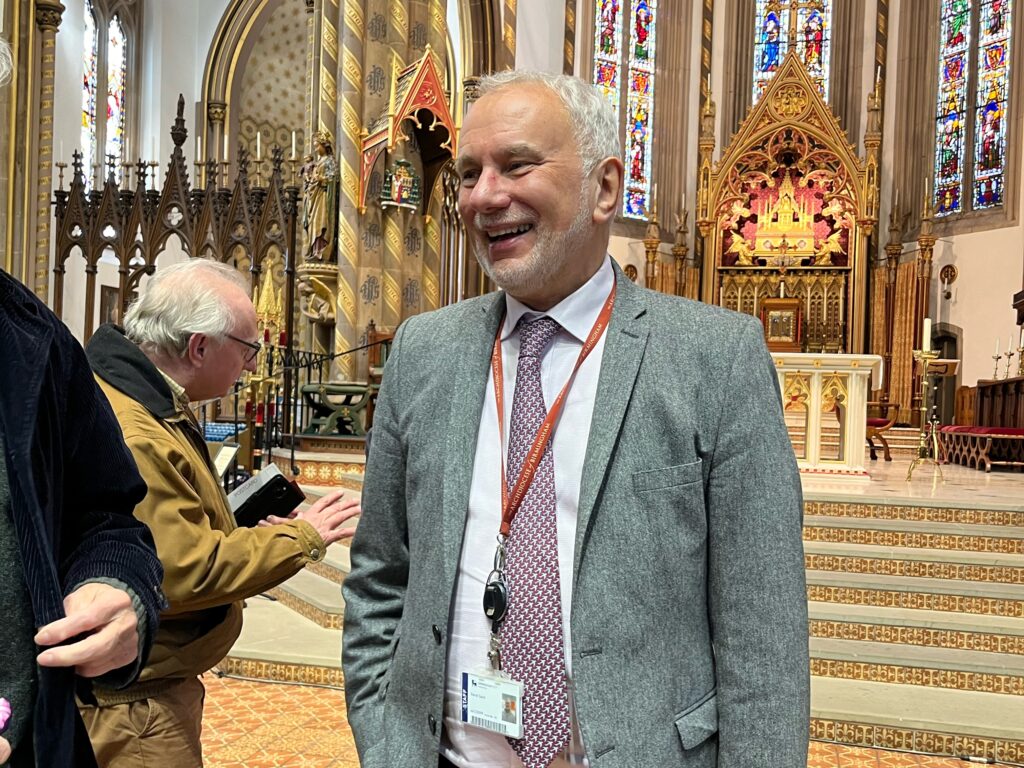
“Its construction, if you see the case on the front, is a miniature version of the big case on the back,” says David.
“So it’s the appearance of it, the structure of it. And the action, which is the mechanism from the keys to the pipes on some organs, is just electric.
“But this organ, it’s just mechanical so it’s a series of rods and levers that eventually pull down the pallet to let the air out of the pipes.
“It is more complicated to build but is very much nicer to the player,” he smiles.
The numbers behind the notes
Such a grand structure also comes at a great cost.
“We started with a budget of… this was 30 years ago obviously… something like £220,000,” recalls David. “And our very able organ adviser got the budget up pretty quickly to £300,000 — that’s quite a big increase!
“It made all the difference to the size and the specification of the instrument.”
Nigel says the Walker requires regular maintenance which is also quite expensive.
“We had it cleaned because there’s so much dirt around with all the building work,” he says, adding that a cleaning just before the pandemic cost £50,000.
The assistant director of music hailed the instrument for its longevity.
“It’s been a great asset because there’s no problems with it,” he says. “It works perfectly, so every week it’s there and can be used. Whereas the older the organ gets, sometimes, as an organist you go and note one play or something won’t work. With this it all works well.”
Putting the cathedral on the map
The vintage organ, which was built as part of the cathedral’s 150th-anniversary restoration, has also earned praise from organists across the world, according to Nigel.

“Most visiting organists who come to play here, particularly from Europe, think it is an absolutely wonderful instrument,” he says.
“It’s certainly put the cathedral on the map because it’s acknowledged as being a very special instrument. It is large but it will play virtually most of the organ repertoire, so it is very useful in that aspect.”
The Walker’s importance extends to the Conservatoire.
“It’s the Conservatoire’s main teaching and examining instrument,” says David, “it is used for competitions and concerts.
“So I think that link for the cathedral with the Conservatoire is a very valuable one.”
The next organ recital is on 7 March at 1.15 pm. Paul Walton, the assistant organist of Bristol Cathedral, will play works by J.S. Bach, Léonce de Saint-Martin, and Petr Eben.