


What is the deeper impact of the refuse workforce’s ongoing industrial action? Daisy Dilys Bourne and James Henry Hickman speak to a union representative, striking bin workers — and members of the public affected by the strike.
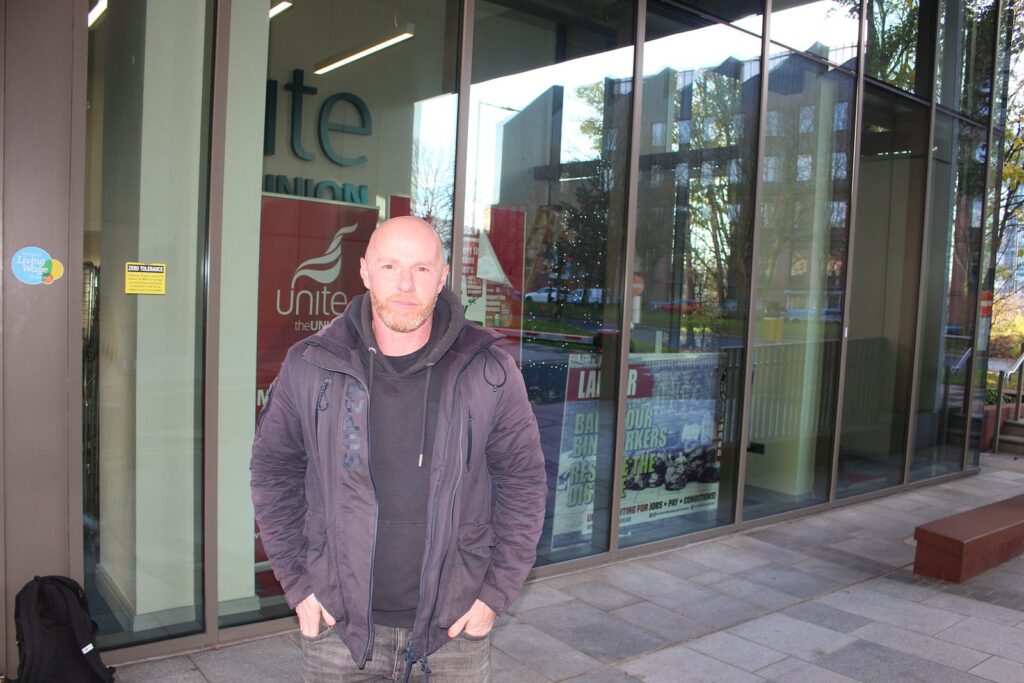
We’ve finished our interview with union representative Matthew Reid and bin worker Sam Yates and are descending in a lift through the levels of the Unite offices when Sam’s expression catches my attention. While Matt stands tall, a hesitant smile resting on his face as he attempts to lift morale, Sam looks tired. Not the kind of tired that a night’s sleep can fix — the kind that leaves you deflated to the core.
At this moment the deeper impact of Birmingham City Council’s (BCC) proposed pay cuts for refuse workers is visible.
For Matt, Sam and other workers, this wave of industrial action began in December 2024. A year on, negotiations are stagnant, with striking workers such as Wendy Yarnold stating: “The council is refusing to talk to Unite and everybody else”.
The council’s communications executive, Thomas Cox, says the organisation has reached the “absolute limit” of what they can offer:
“Unite’s demands would leave us with another equal pay bill of hundreds of millions of pounds — negotiations are therefore no longer taking place,” he says.
Now, workers including Job&Talent agency staff have balloted to strike through March 2026.
Wider boundaries
As we conduct the interview Christmas festivities — and the increased paper and food waste that generates — are fast-approaching. Local elections are due to take place on 7th May 2026. Local voters wonder where the dispute leaves the community, workers, Labour party — and the environment?
While this dispute originates in Birmingham, it crosses wider boundaries: from the Your Party conference in Coventry, at which Matt delivered a rallying cry, to the ballpark deal proposed by BCC to Unite, which was blocked partly by Westminster commissioners in May. Matthew Reid explained to us:
“We woke up one morning and Birmingham City Council decided to take £8,000 off the WRCOs (Waste and Recycling Collections Officers) [a grade three role], which were the loaders, and then halfway through that dispute, they did the same to the driver team leaders.
“There are 1500 roles within Birmingham City Council and these are the only two roles that have not been through job evaluation”.
Matt says there are a “significant number” of people who will lose the full £8,000, and a smaller number that will lose £5,000-£7,000 depending on where they are on the pay scale.
“The top wage for drivers before this would have been around £40,000 . The bottom would have been around £32,000. For loaders, the bottom was around £25,000 — the top, around £32,500”.
The impact is not limited to the contracted refuse workers, nor the financial burden.
“An unbelievable financial and emotional pressure on workers’ families”
In his Your Party speech, Matt said: “This is all happening under the control of a Labour government and council that, instead of standing for and with working people, are allowing employers to use union-busting tactics and legislation to worsen pay terms and conditions and make industrial action protests as ineffective as possible.”
He drew particular attention to the practice of ‘fire and rehire’ — also referred to as ‘dismiss and reengage’ — the practice of “sacking workers, tearing up contracts, rehiring them on worse pay, worse conditions, with fewer rights”.
Striking workers have claimed they have faced threats of blacklisting and bullying. According to Unite, bin drivers in the city employed by the Job&Talent employment agency “have been subjected to the ‘bullying tactic’ of having their driving ‘performances’ publicly ranked in a league table posted on their staffroom wall”.
Birmingham City Council press and PR manager Sarah Kirby repeated the council’s rejection of the claims, calling them “unfounded”:
“Our crews’ and contractors’ workloads are in line with industry standards,” she told Birmingham Eastside, “with crew performance monitored [by both council management and the agency] to ensure collection standards are met. Crews are supported throughout their employment.”
“There could not legally be any new ‘Equal Pay’ claim”
The council claims that agreeing to the union’s demands would make them liable to further equal pay claims.
“We must pay fairly and equitably across the council in all circumstances,” says Cox. “We will not perpetuate the mistakes of the past and re-open the potential for equal pay claims by making potentially unlawful payments to settle the waste dispute.”
But Matt argues that the council is merely repeating a previous statements and failing to respond to claims raised in a briefing that “No one else is being treated as we’re being treated in the council”
A council spokesperson says it is “aware of Unite’s position as regards the likelihood of new and extended equal pay claims in respect of any payments the Council makes to the waste operatives in the waste service to settle the dispute. The Council does not recognise or agree with Unite’s position”. When asked to specify the reasons for this, the council did not respond.
The “spin” of current productivity
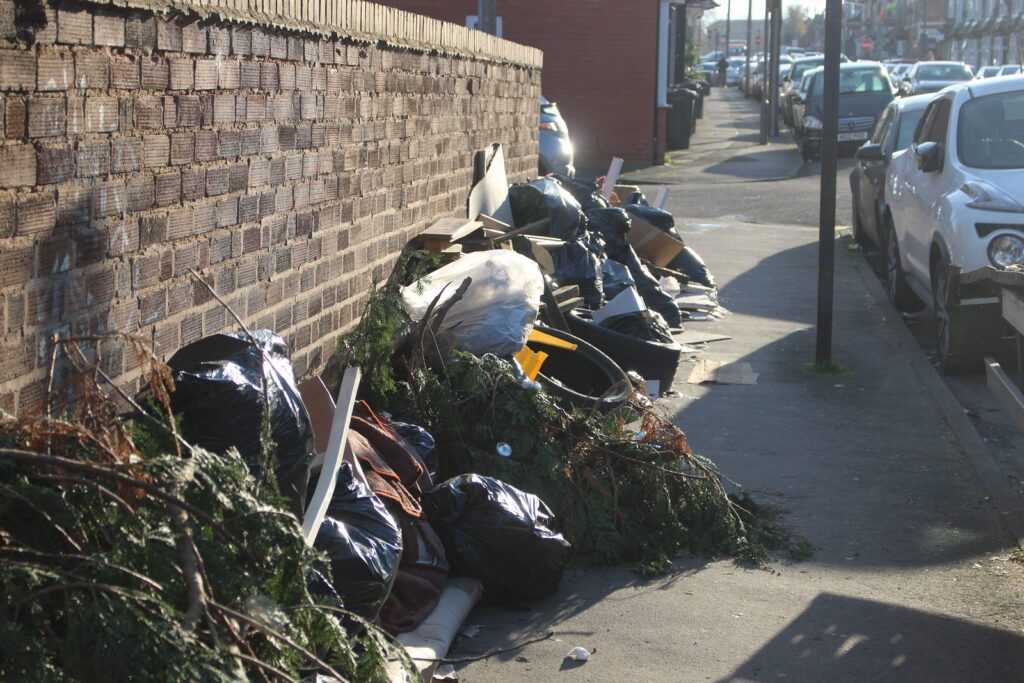
The council claims there has been a 22 per cent increase in tonnage of waste collected per employee regarding missed collections and a 52 per cent improvement.
“No”, Matt says with a weary smile, sighing. “This is a spin”.
The increases, he says, are due to people are putting recycling material, which is no longer being collected, in regular waste bins. Those now, he says, “weigh twice as much”.
Matt suggests figures showing missed collections have dropped by 50% are also related to the council providing a reduced service, with garden waste and recycling collections both on hold.
Amongst the workers: Sam, Wendy and Craige
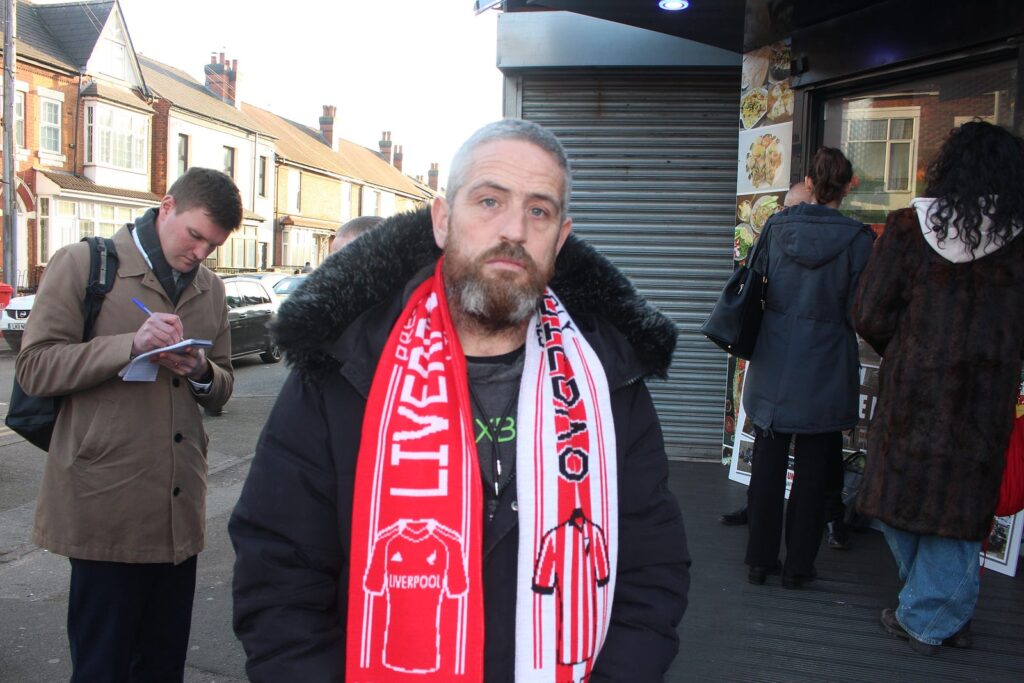
In a spacious, quiet conference room in the Unite offices, Sam Yates, 47 years old, sits opposite me. Having spent the majority of his adult life working his way up to the “charge hand” role, or what in this dispute is termed the WRCO role, Sam faces an uncertain two decades of working life ahead.
“At this point in time, I feel completely useless,” he says. “I’m going to the picket line, I’m there two to three hours and then I go home and I’m literally…”
He pauses, looking at no one in particular — the silence is deafening.
“I put on weight.”
Matthew Reid shuffles and smiles tongue-in-cheek: “I didn’t want to say anything, but… yeah.”
“My wife suffers from severe anxiety anyway,” Sam continues. “So you’ve got that added element. I just…” — he hesitates — “I don’t feel like a breadwinner, because I haven’t done anything”.
Recalling a day on the picket line, he adds that a police officer who was profiling him to a colleague referred to him as “dishevelled”.
“I want it on the record,” Matt jokes, “that Sam was dishevelled.”
On the issue of agency staff stepping in, there is a sense of loyalty between agency members who worked in the depots prior to the action and those contracted workers walking out.
“The ones that were there before we went on strike, we knew them personally — friends, sons, best mates.
“I said: ‘Look, please just do one thing for me: don’t do overtime.’ The ones that we spoke to didn’t do it”.
At the depot
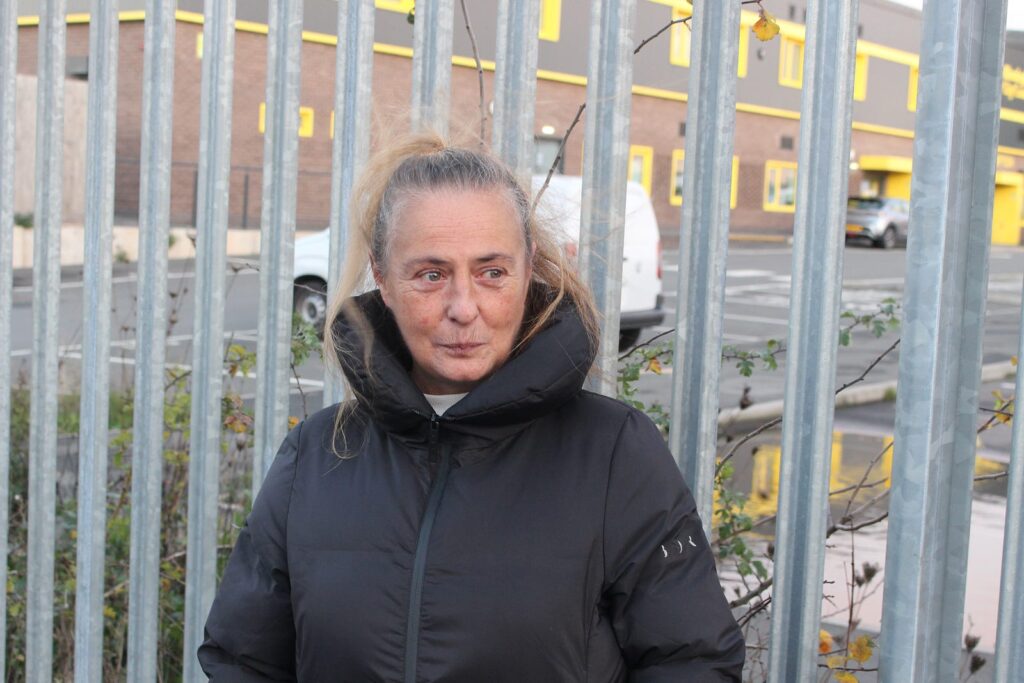
Wendy Yarnold has been a contracted refuse worker for five years and was an agency worker for four beforehand, approaching a milestone anniversary in the service. What she lacks in height, she makes up for tenfold in her determined demeanour — despite the freezing temperatures at this time in late November.
She is accustomed to this weather by now, standing proudly outside the Tyseley depot with the colleagues she characterises as “family”.
In December last year Wendy and her colleagues received letters to say they were being downgraded from a grade three to a grade two.
“It means I lose £600 a month: £8,000 a year. I’m a single parent: I’ve brought up three children on my own. I’ve got a family home which I’m now looking to downsize. The impact is absolutely astronomical.
“Everything’s going up in price yet our money’s going nowhere. We haven’t been asking for pay-rises: we’re asking to keep our money — and we stand here Monday to Friday.
“The only thing that lifts us is each other’s spirits”
While Wendy has the perspective of an agency-turned-contracted council worker, Wendy’s sons are agency workers.
“It has caused friction between us all — it really has. I’ve got one son who is on street cleansing and one who is on the bins.
“My son on the bins used to work with me every day — it’s horrible. He used to hang his head coming out of the yard, seeing me standing there. It was heartbreaking”.
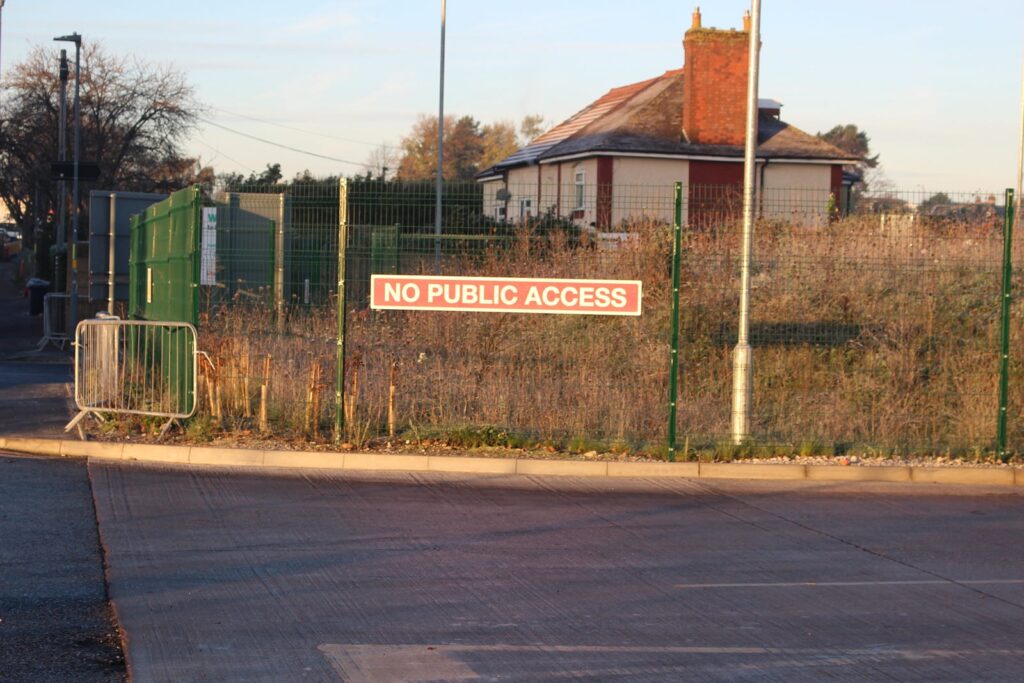
Wendy emphasises the importance of the Waste and Recycling Collections Officer (WRCO) role. Birmingham City Council claims that no other authority has this role. Matt suggests this is misleading:
“The WRCO role was appointed in the aftermath of the 2017 strike. That was a mistake, that we allowed them to call it something else. Yes, no other council in the country has a WRCO [but they do have that role]. They call them leading hands, charge hands”.
The responsibilities of the charge hand — Wendy’s role — appear to have been undermined. She explains:
“Drivers cannot be our health and safety. They are concentrating on the front of the truck: pedestrians, crossing cars… the WRCO is the health and safety on the back of the wagon. An accident could occur in a split second, especially if you’re not concentrating.
“It’s called a kill zone in between the wagons — for good reason. Some of the lads, especially the young agents, they come in thinking ‘yeah, I can do this, I can do that’. Say, they forget to move a bin — it could fall off and knock you clean out.
“I’ve got to be their eyes and ears as well as my own”.
It is this technical responsibility which partly defines the dispute. Another is the sense of responsibility for residents.
“We might be the only people some residents see, the only person they see every two weeks. I tend to stay there and have a little chat with them — it livens their spirits. Same as it lifts yours”.
Wendy emphasises that women as well as men, especially recently, help to form the backbone of the industry. “You fit in. It doesn’t matter”.
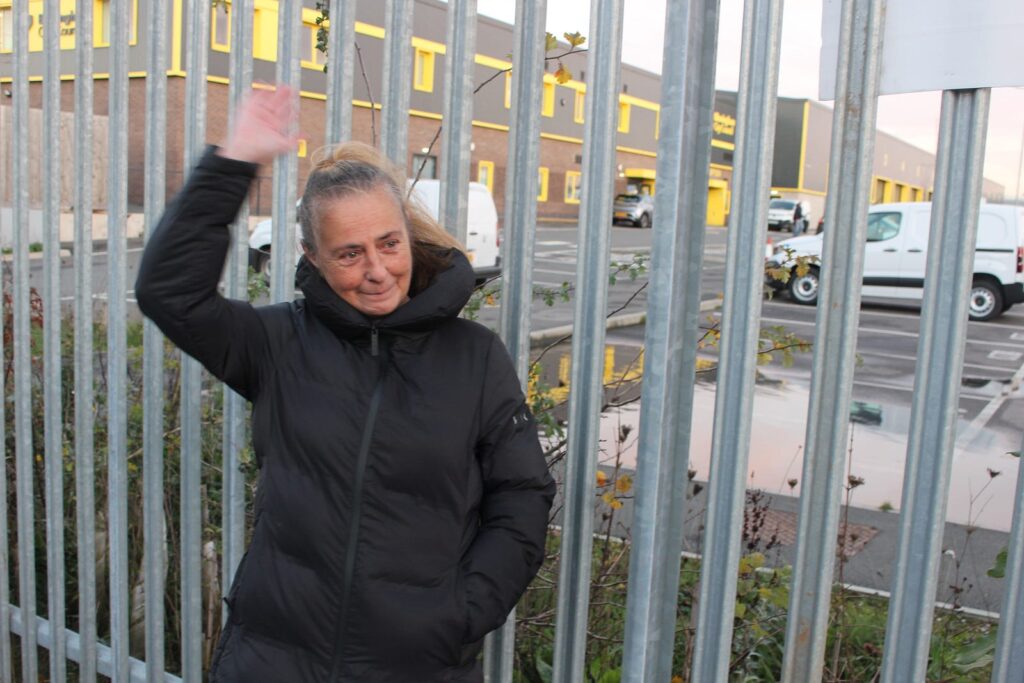
“Especially in the winter, it’s a lot to be here from 6am”
Wendy’s feeling of each yard being connected rings true at the Perry Barr picket, a diverse group of workers standing in solidarity together, not just physically but also in spirit across the city.
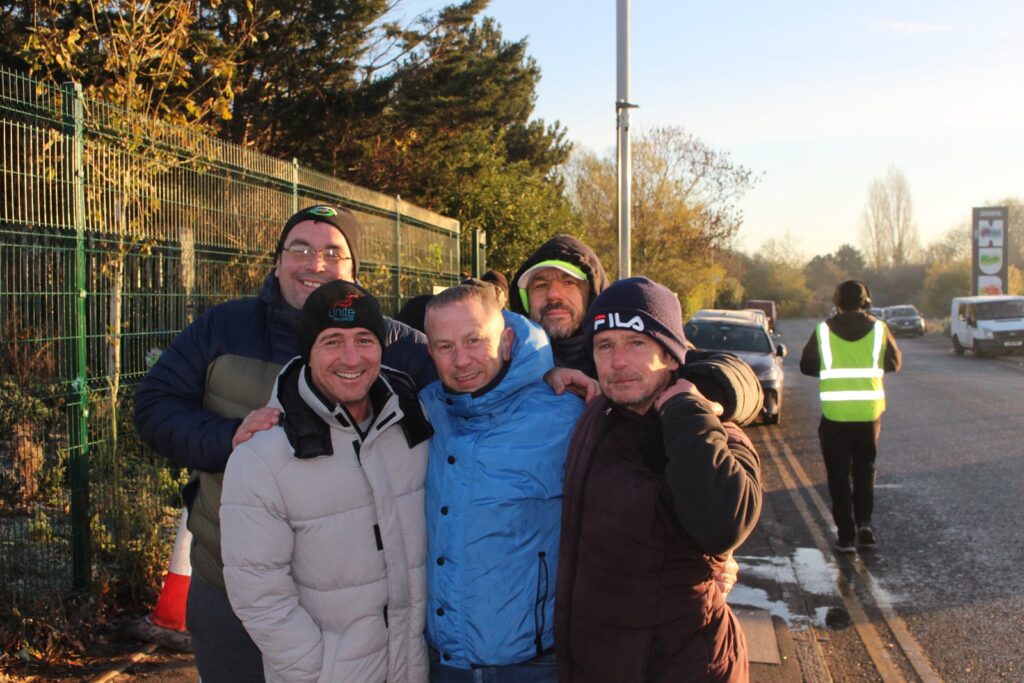
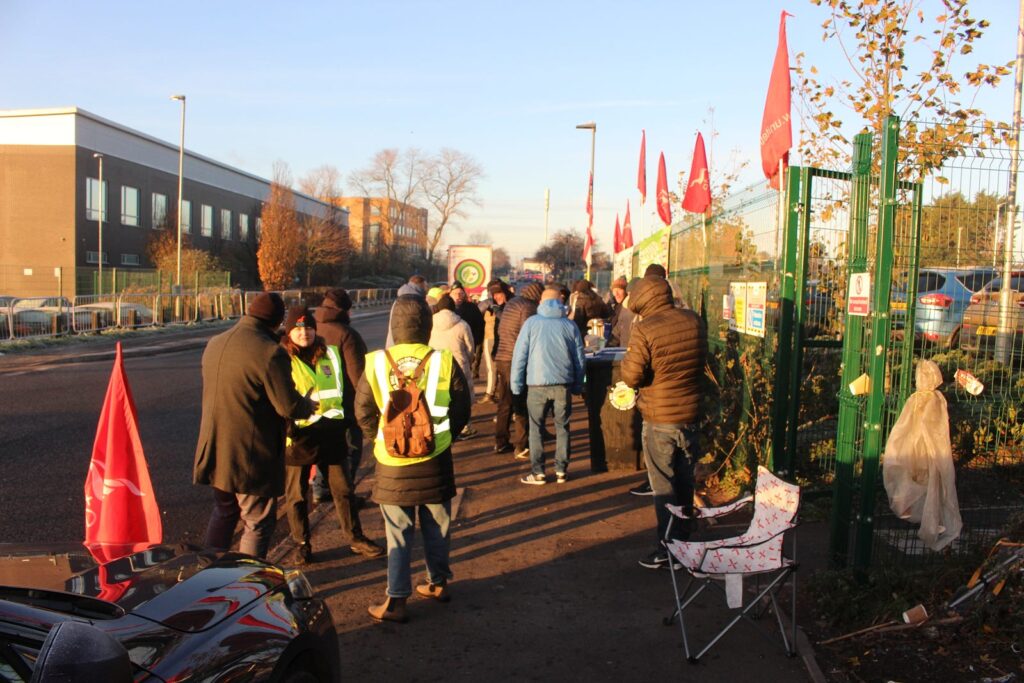
My breath creates a big cloud of steam in the cold morning air, echoed by the steam emanating from the hot drinks provided along the Perry Barr picket line. As we approach, The Chemical Brothers’ ‘Hey Boy Hey Girl’ blares from a speaker.
Some lorries, driven by agency workers, leave and enter the depot. The atmosphere becomes more tense. Firm glances linger between the picketers and agency. I continue my conversation with Craige Roberts, who has been on the line since action began, and today, since 5:30am. It is now 8:30am.
Like Wendy, before being contracted Craige worked for the agency for years.
“It took a long time for me to get a full-time job. Even years ago — people only talk now of their tactics within the council of bullying the agency because you’re on zero contract hours — that’s been happening for many, many years.
“There are quite a few of them [agency staff], even now, who’ve taken the plunge to say, ‘we need to come out because we are being bullied and intimidated’”.
Public perception
Matt and Sam suggest that it feels as though they are taken for granted, that people don’t appreciate what bin workers do until their service stops. Wendy speaks of the everyday local support, and a brighter side of the job, such as residents leaving out gifts for workers, like chocolate boxes and kind notes. Craige mentions local people providing much-appreciated food and drinks along the line, and says he has been told: “We understand what you’re up against”
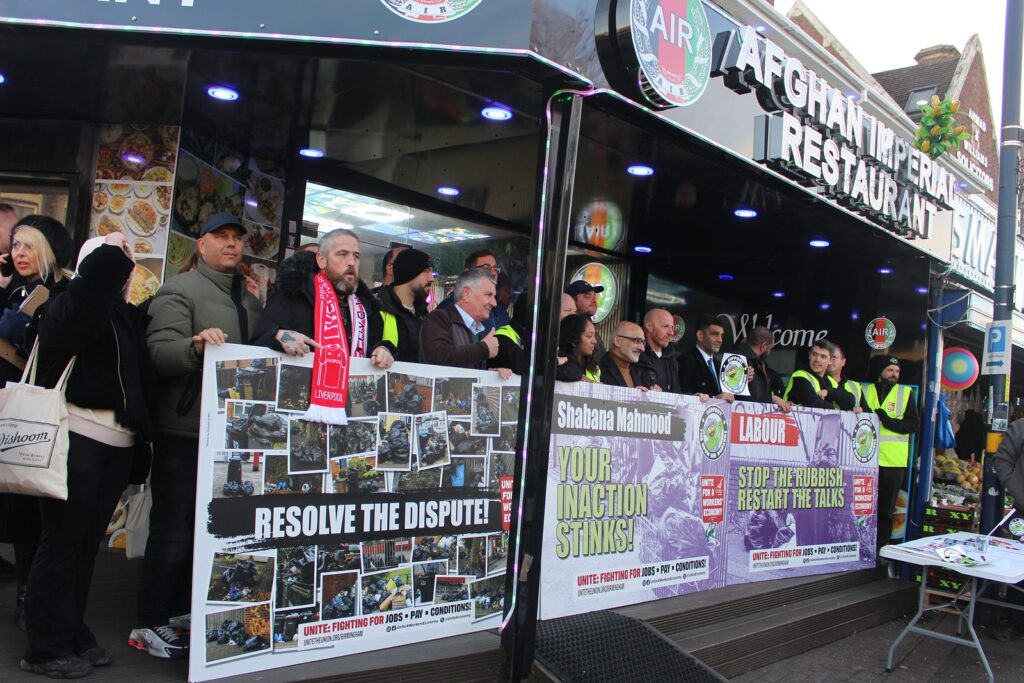
At the Afghan Imperial Restaurant in Alum Rock, the scents of spices and the simmering buzz of chatter waft out into the street, enticing community members and striking workers alike. This is an event organised by Claire Peden, Unite Organiser, and Joe Rollin, Senior Organiser at Unite, who explains:
“It’s important to show the council that no matter what they say, the reality is that people understand that normal working people can’t afford an £8,000 pay-cut.
He describes the event as the culmination of significant work done in the Home Secretary Shabana Mahmood’s constituency.
“We’ve been speaking to local businesses, community groups and religious groups. We want to bring them all together today in a show of strength to ensure the Home Secretary knows they need to solve this dispute”.
Among the big demonstrations around the city, a smaller event such as this still seems especially valuable to organisers.
Birmingham resident Stuart Richardson, who lives in Erdington and has faced missed collections, says: “I’m shocked by how drastic the Labour council has become. The proposal by a Labour — yes, a Labour — council to cut the pay of workers, some of them working for about 30 years, by 20% is just unprecedented”.
A Moseley resident, who did not wish to be named, emphasised the importance of looking after our community. “These days, everybody’s for himself. If we don’t care for others, we’re going to be in a worse situation”.
Local students Julian, Marie and Will are also at the event. Julian says: “The workers need to take the power back, the ownership of the means of production, and that’s really the way forward for us”
Will, living in a student house in Selly Oak, tells us that he has seen bins piling up around the area — but that it doesn’t affect his sense of solidarity with the workers.
“I’d much rather my bins not be taken for a little bit and the workers be treated fairly and paid accordingly than the alternative. We’ve seen a lot of students in Selly Oak who understand the necessity for the bins not being taken out, and while it’s a little hard to deal with, it is worth it”.
Marie says: “It’s a struggle against austerity and it’s a struggle against what the council has been doing”
Caring for the climate
One of the concerns raised at the event is the effect of the dispute on recycling. Matt agrees: “It’s going to be so hard to get people back to the way they worked before,” he says.
“The council has spent £14 million so far in direct costs — our accountants have worked out that that will be £26 million direct costs by the end of the financial year.
“That doesn’t even include indirect costs, like the garden subscriptions and the money that they get from the recycling. The environmental impact of burning all of this recycling is just” — he shakes his head — “horrendous”.

Agency development
In their dispute factsheet, published in April, Birmingham City Council said:
“We continue to operate with the same number of agency workers throughout the current industrial dispute. We are extremely grateful for their ongoing support.”
From March to December 2024, the council spent £5.7 million on the Job&Talent agency (otherwise known as “Extra Personnel”). From January to August 2025, this spending increased to £8.2 million, a 43% increase.
“Technically, they are telling the truth,” says Matt. ”Because they flooded the depots in December. They’ll never say ‘we’re not using any more agency than we did in November’. We know they were working potentially with around 150–180 agency staff in November last year — [at the] same time this year, it’s over 300”.
According to Matt, BCC’s claim of looking to provide permanent contracts to agency workers is misleading.
“For all those agents who are in line there are basically 20 jobs for between 100 of them. You’ve got a one-in-five chance of getting a job”.
Wendy agrees: “It’s heartbreaking for the young lads and lassies”.
Matt says that agency workers are tracked and controlled in their numbered wagons, and that staff are penalised if they talk with striking workers.
“The thing [the council] don’t realise, is as soon as those men and women become full-time members of staff and have that council contract protection, they all turn into us. They can’t be pushed around anymore”.
“They’re getting texts from Job&Talent,” adds Sam, “saying, ‘for health and safety reasons, you need to have your windows up, your doors shut’. This is a way to cut off communication.”
Tired, confused… hopeful?
In their response to the agency ballot, a spokesperson for BCC said:
“While we are disappointed the dispute has not been resolved as Unite has rejected all our offers, we are continuing to make regular waste collections and our contingency plan is working.
“A small number of agency staff are in a separate dispute with Job&Talent. The city council has contingency plans and will continue to look to maintain residents with a minimum of one collection a week”.
Matt is focused on the “small number” mentioned in the response. “They’re the cavalry,” he says. “It’s better late than never. To refuse to cross the picket line now without protection is incredibly brave.
“We came out on the 6th January under full protection, with a full-time contract with an employer. 22 [agency staff] joined — they are harassed, bullied — they’re doing extra work.
“We only balloted 22 — since then, I think another 60 have joined Unite. More people can join. We’ve got 40 who are refusing to cross picket lines already — that was a day after the ballot”.
Agency staff walked out on 1st December.
In our last interview, Matt seemed exasperated. “They could have avoided this from the start,” he says. “They could have done the evaluations — we couldn’t have argued because that’s how it was evaluated. But they weren’t going to get the result they wanted”.
In his Your Party speech, Matt said that this dispute began in Birmingham and it should end in and with Birmingham.
Craige Roberts agrees, hoping “the fight” for many workers will end soon.
Wendy agrees. “Come back around this table,” she urges the council. “Talk to us. There’s got to be some halfway measure”.
For an additional dive into this story watch James Henry Hickman’s video explainer on the numbers behind the strike.