

In Japanese universities women compete every year in beauty contests. Ryo Nishiyama looks at the relationships between the contest, the advertising industry — and stealth marketing.
Every year in Japan dozens of universities hold a beauty contest called “Miss Con”, with winners at prominent institutions such as Tokyo University attracting mass media attention every year, and The Miss of Miss contest 2023 being held at Yoyogi National Gymnasium — the venue of the Olympic games, NHL, and Sam Smith concert.
The popular competition is a gateway to careers in TV, modelling and acting, with prizes including appearances on TV CM and in a popular fashion magazine, and many previous award winners active in those industries.
Analysis of women announcers on TV Asahi and Fuji Television, for example, finds that over 30 per cent had entered a Miss University, Miss Universe, Miss International or local ‘miss’ contest.
But analysis of finalists’ social media presence reveals how the contest is also an important vehicle for cosmetic companies to promote their brands — with widespread use of controversial “stealth marketing” techniques.
One third of finalists’ Instagram posts contain PR content
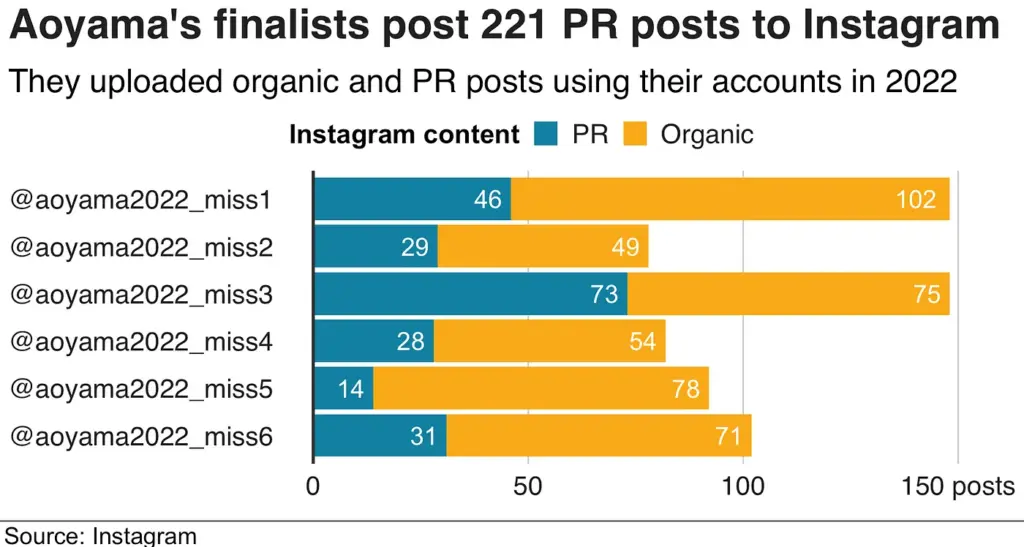
The contest of Aoyama Gakuin University, located in Shibuya, the busiest area of Tokyo, attracts the most attention (the private Christian university vehemently denies any relationship with the organiser). Its finalists in 2022 posted on Instagram 650 times — with 34 per cent of the posts containing PR content.
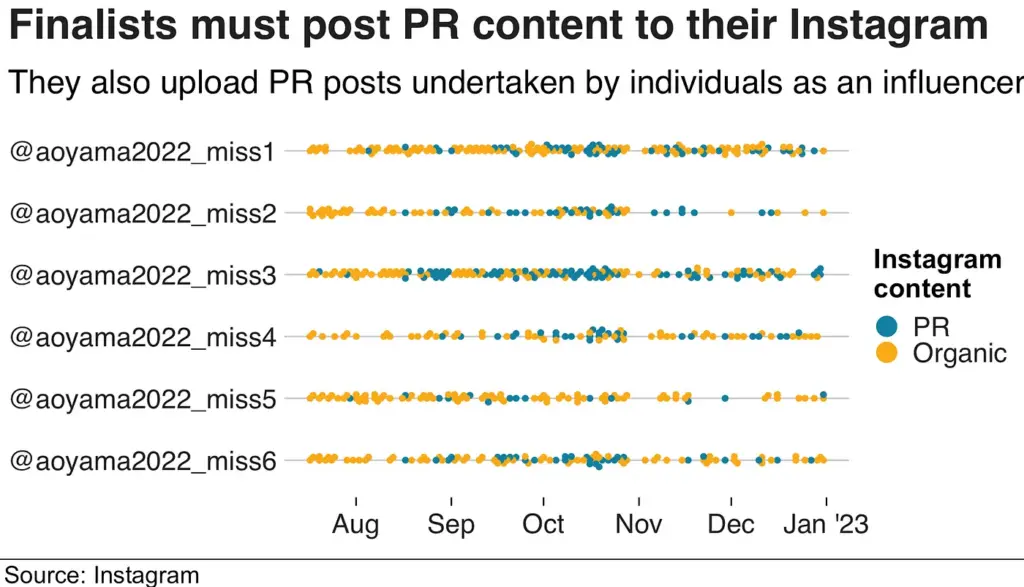
For the first month of the contest most posts are organic — in other words, ordinary posts which do not include promotions — but as the competition progresses candidates begin to increasingly use their accounts to promote goods for sponsors and clients, peaking as the final approached on 29 October.
Posts by five of the six Aoyama’s finalists then started to be deleted from Instagram at the beginning of April 2023. One candidate, an aspiring TV announcer, deleted over 70 per cent of PR posts.
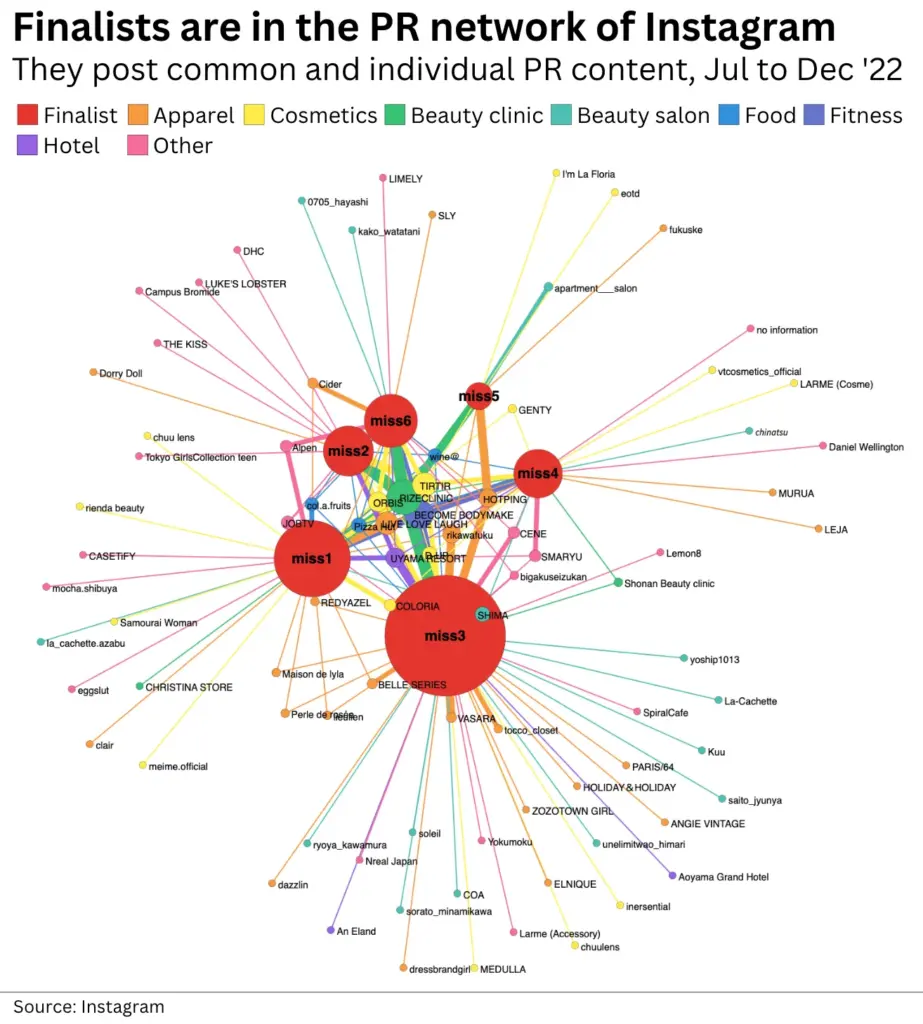
Aoyama’s finalists are part of a vast PR network on Instagram.
The main sponsor of the competition, the hair removal clinic RIZECLINIC, is a typical example: six candidates uploaded posts with the company name and the hashtag which means “to a clear skin”.
All finalists except for the eventual winner also posted PR content by companies without a direct sponsorship link with the competition. The candidate @aoyama2022_miss3, for example, posted PR content related to over 20 non-sponsor companies.
Clothing and cosmetic companies feature most heavily in the Instagram updates by the candidates, followed by beauty clinics and salons. Food and restaurants, work, fitness, hotels and accessory brands also featured.
#PR hashtag missing from over 70% of commercial posts
Promotional content on Instagram is supposed to include the hashtag #PR to indicate its commercial nature — however, over 70 per cent of the PR content by finalists does not use that hashtag.
Posting promotional material without including the #PR hashtag is called stealth marketing, and omitting the #PR tag is considered unfair in a number of countries. In October 2023, Japan will begin regulating stealth marketing through the Law on Unjustifiable Premiums and Misleading Representations.
Some advertisers do use a hashtag to indicate the nature of material: cosmetic brand ORBIS’s PR content has the #orbis_pr in eight out of nine posts, for example.
In contrast, only two in every 12 posts about Korean cosmetic brand TIRTIR use the #PR hashtag.
One image of beauty being advertised

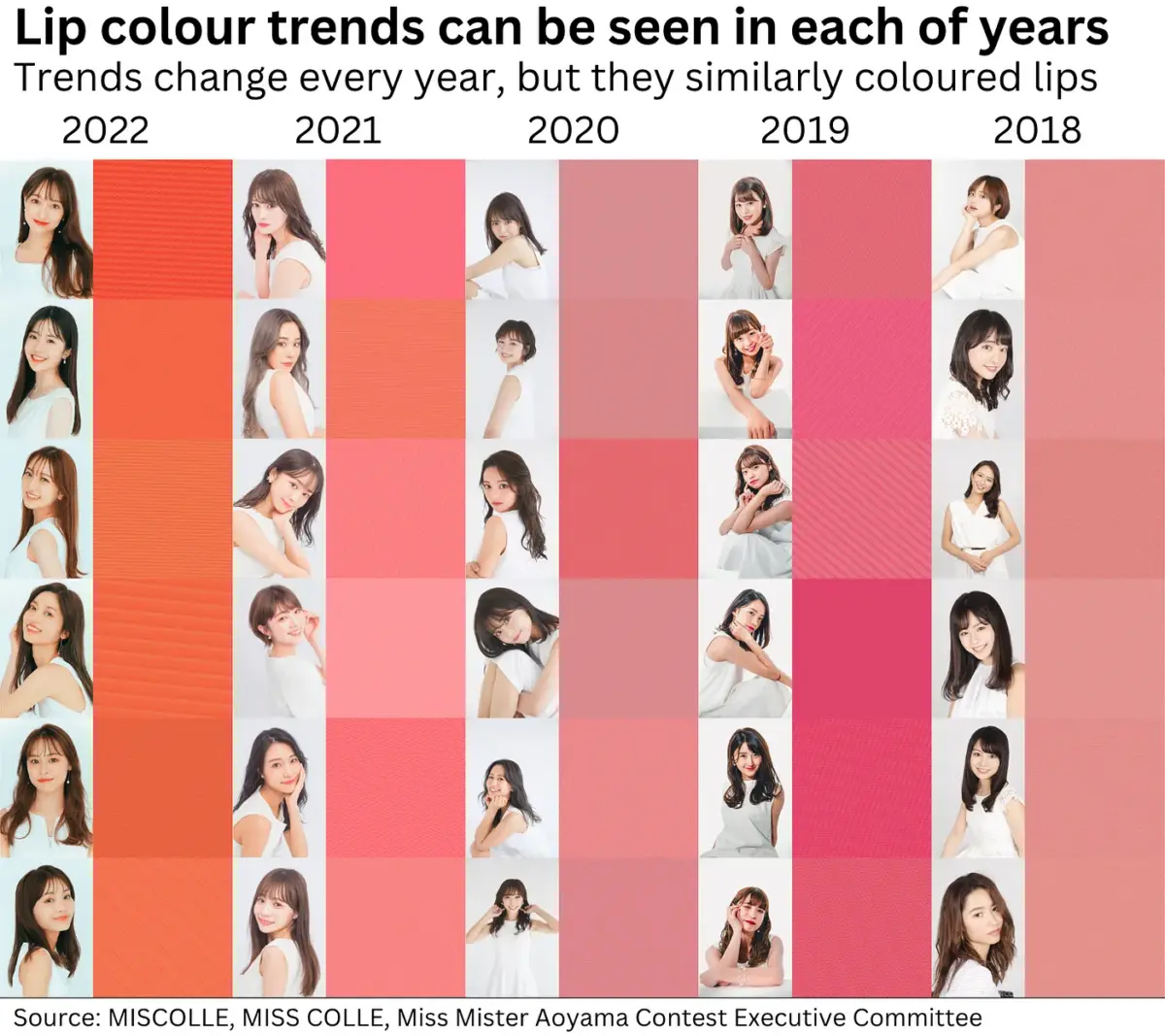
Finalists in the competition tend to adopt similar hair colours and styles: in 2021 five out of six finalists in 2021 had the same fringe style — called “see-through”, while the hair colour trend in 2022 is a bright orange-based one.
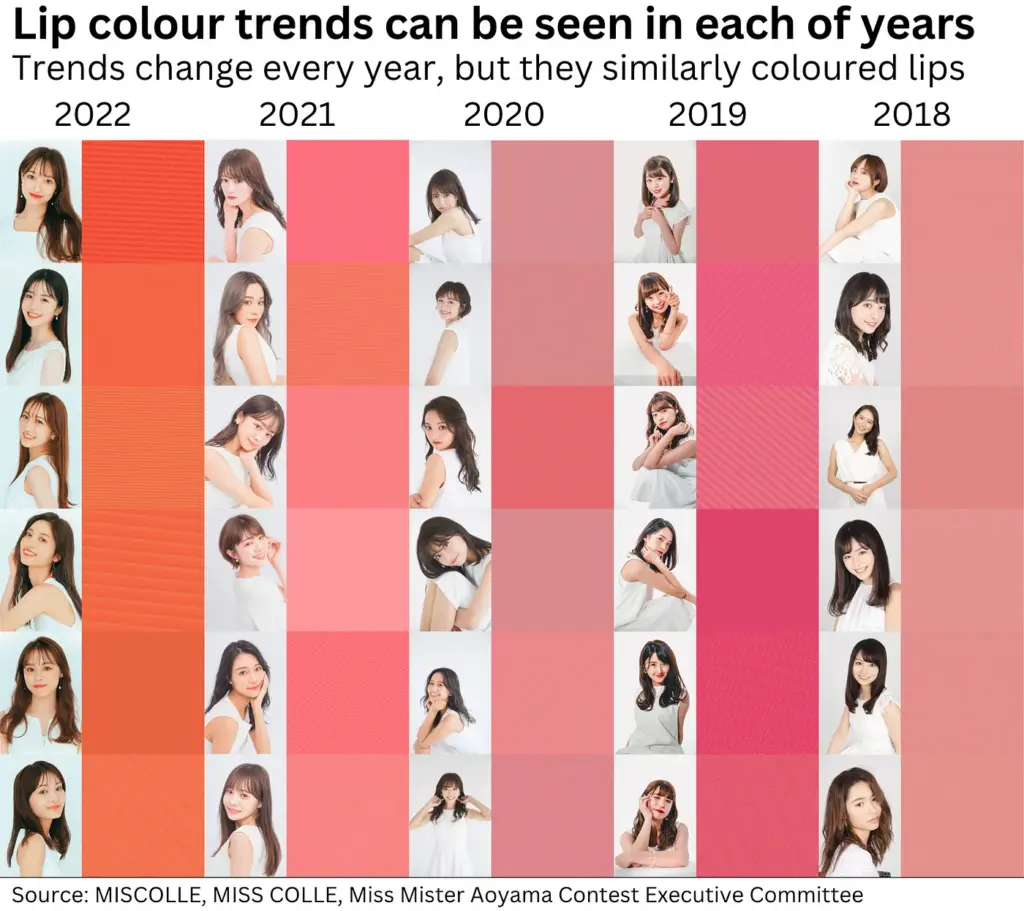
Lip colour trends can be seen even more clearly: 2022’s trend was orange-based, for example, while 2019’s finalists preferred the deepest pink, and in 2018 light pink lipstick dominated.
A competition facing challenges
Criticised for judging candidates only on their appearance, organisers have begun to include other criteria such as contribution to society, while some universities have cancelled the events.
The organiser of the Tokyo University’s contest was accused of sexual and alcohol-related harassment by the candidate Kamiya Asa in 2020.
Kamiya also criticised the evaluation system of the contest on Instagram Live before she won the Miss Tokyo University and Miss of Miss contest. She said, “The contest is a game based on paying. I got over 2 million points (yen) in the previous live-streaming. I am distressed.”
A version of this story was first published on Medium here.